Local Model Benchmarks

Local test machine: Apple M5 Pro · 64 GB unified memoryRun window 29 September — 18 October 202622 recorded runs

Workload · Task-loop orchestrator · interactive figure · Revision 1

Microwave Oven Anatomy

A long, visual brief for the task-loop orchestrator: an interactive isometric cutaway of a countertop microwave oven, built with the anatomy skill, that explains how it heats food. The object is given; the challenge is drawing it in detail and getting the physics right.

2 recorded attempts

The builds, side by side

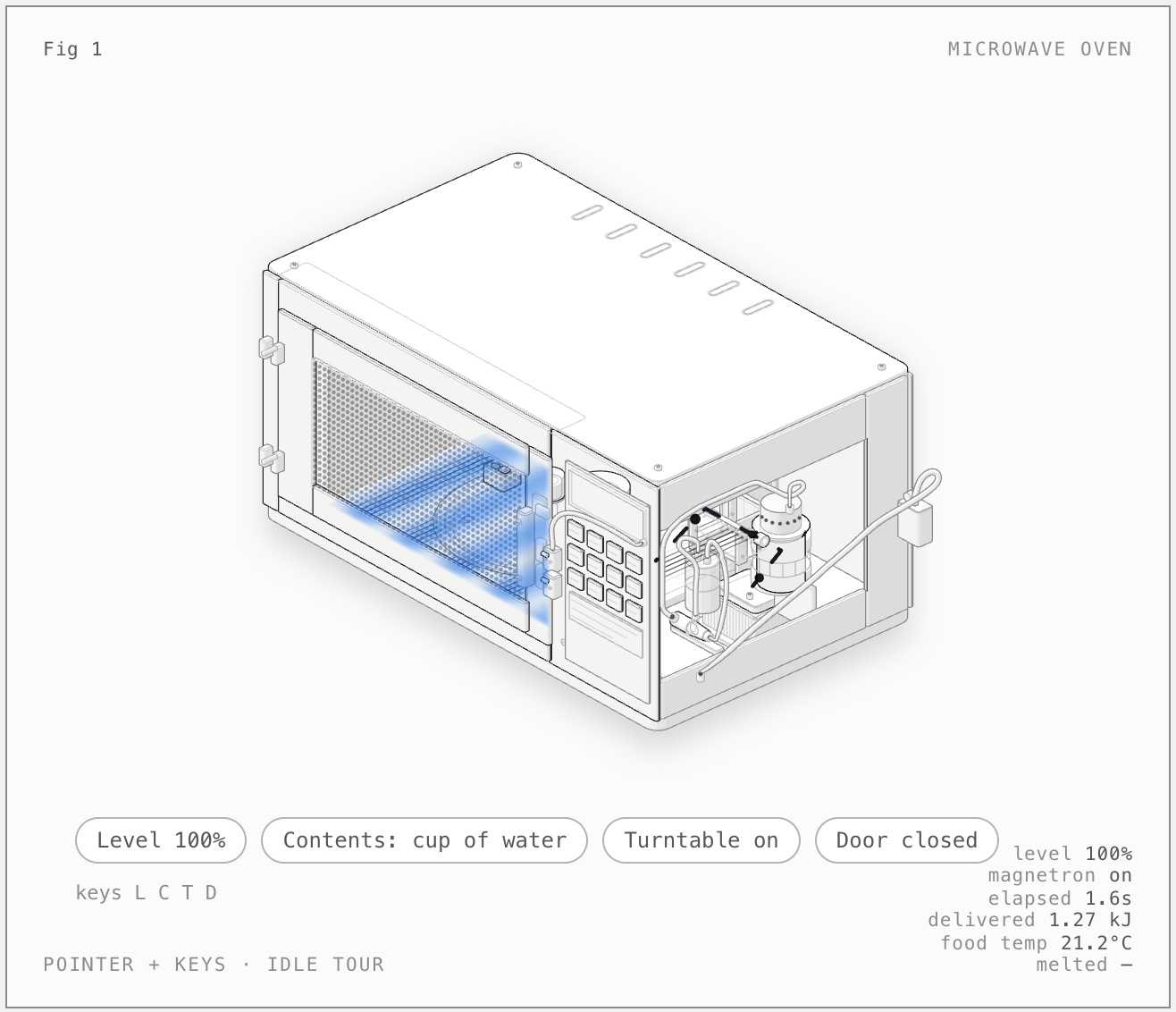
Isometric cutaway of a countertop microwave oven with its mesh door, keypad, magnetron and cables, above power, contents, turntable and door controls
Microwave Oven Anatomy · Sushi 1.2.2 → 1.2.3 · interactive figure

13–15 October 2026

Qwen 3.8 Flash Next

Sushi 1.2.2 → 1.2.3 · Pi 1.1.0 + task-loop orchestrator

Session completed Local run

COMPLETE after 17 h 20 min: a detailed microwave cutaway, 52 project checks, and 15 of 16 hidden acceptance cases (the frozen block warms ten times too fast).

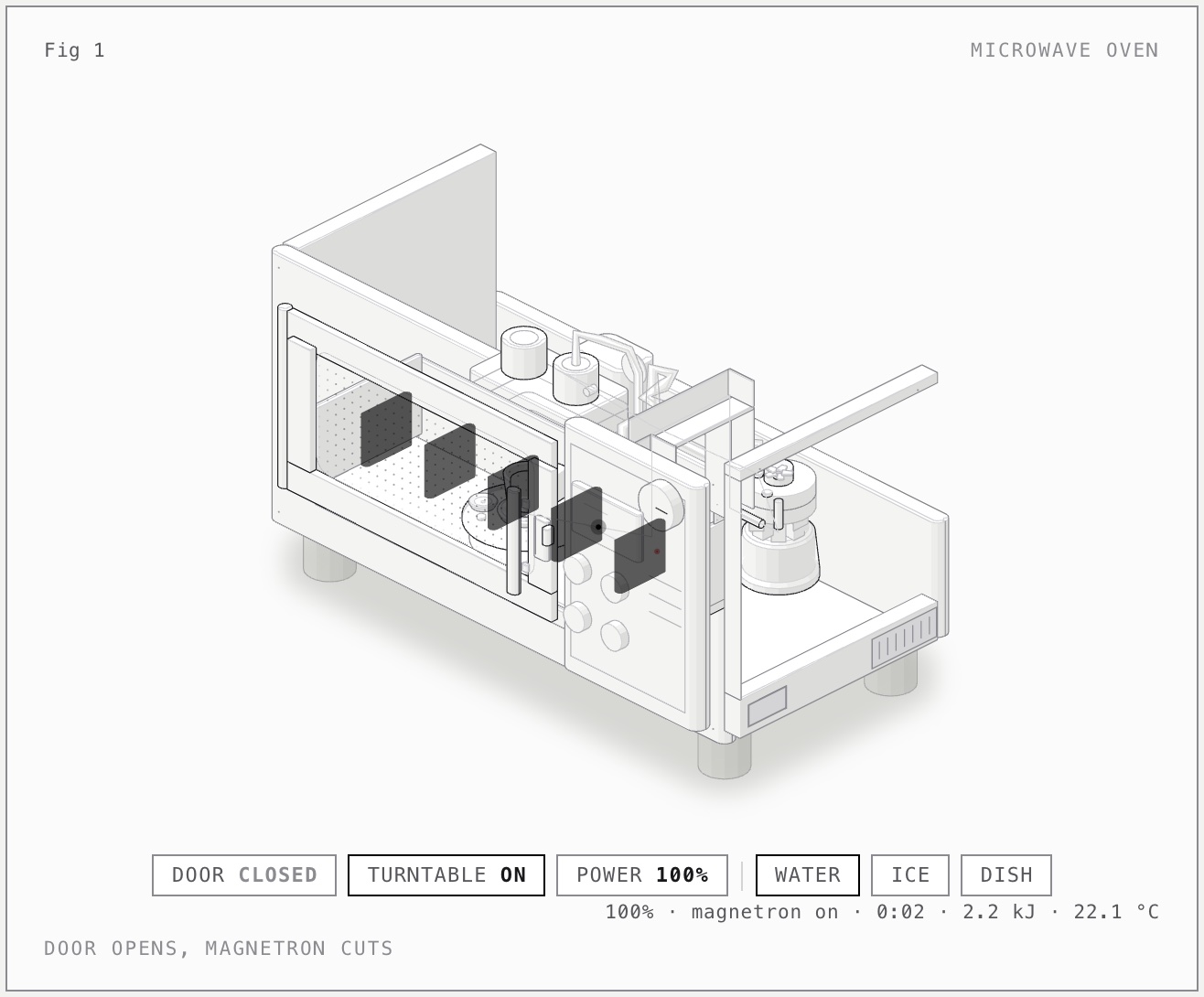
Isometric cutaway of a countertop microwave oven with its transformer bay, magnetron and fan, cavity and turntable, above door, turntable, power and contents buttons
Microwave Oven Anatomy · Splash 1.3.1 · interactive figure

15–16 October 2026

Qwen 3.8 27B

Splash 1.3.1 · Pi 1.1.0 + task-loop orchestrator

Session completed Local run

COMPLETE after 29 h 1 min with no operator action: a cluttered but complete cutaway, 67 project checks, and 16 of 16 hidden acceptance cases. Default sampling, so not a like-for-like comparison.

From the run records

Measured side by side

Wall time
Output tokens
Tool calls
Decode speed
Largest prompt

Each attempt used its own engine, harness version and settings, and some sessions include waiting or outages. Hover a value for its exact definition, and read the run sheets before drawing conclusions. Cloud wall time includes provider queueing; local decode speed is per request on this machine.

Task requirements & full brief

Built with the anatomy skill loaded in every session. Runs are also scored with hidden acceptance cases written from the brief; the model's own checks can encode a misreading of it.

  • Draw a real countertop microwave as a cutaway: transformer, capacitor and diode, magnetron, waveguide, cavity, turntable and mesh door.
  • Show the energy travel from the transformer into the cavity, and stop it when the door opens.
  • Power levels as an on/off duty cycle, with water, a frozen block or an empty dish inside.
  • A live readout of power, elapsed time, energy, and temperature or melted share, from a pure model module.
  • Dark and light standalone pages, with the skill's geometry audit, line-end check and screenshots in verify.
How to read this comparison

Compare the generated builds and the checks recorded for each attempt. There is no normalised quality score, and the cloud task’s cumulative token totals and end-to-end rate include repeated context, reasoning, tool calls and waiting — they are not comparable with local per-request decode or prefill rates. The method page sets out which figures can and cannot be set against each other.